Sifaat al-Huruf: Why Your Letters Sound Wrong Even When Your Tongue Is Correct
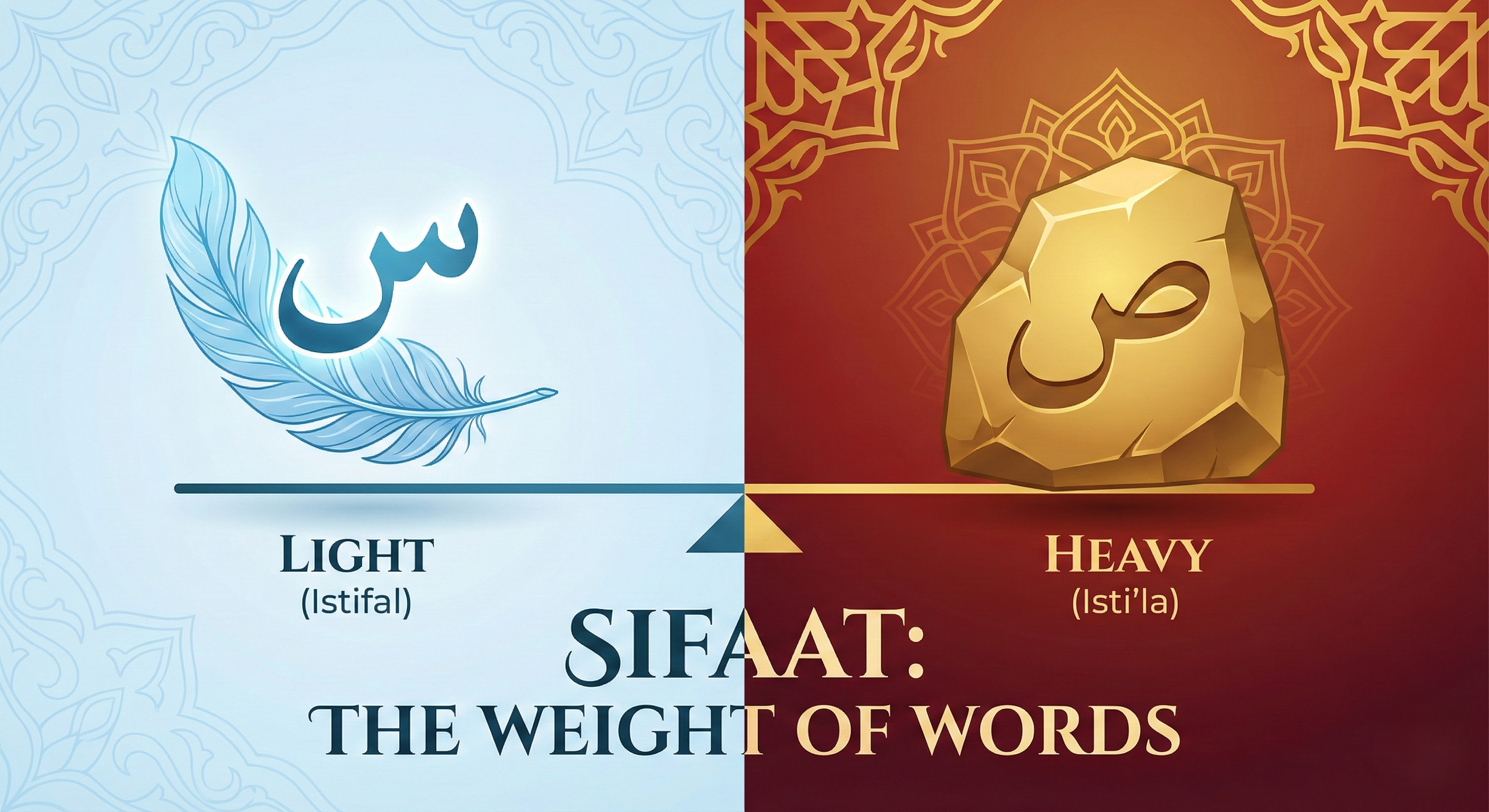
“Teacher, my Seen sounds like Saad.”
“I know where my tongue goes, but my Taa still sounds weak.”
If you have ever felt this confusion silently—you are not alone. This is one of the most common problems faced by Quran learners worldwide.
👉 The Reality: Most students fail in Tajweed not because of wrong Makharij, but because of weak Sifaat.
From Position to Personality
In our previous lesson on Makharij, we learned where each letter originates. Now imagine this:
Makhraj is the HOUSE.
Sifaat is the PERSONALITY living inside that house.
Seen (س) and Saad (ص) live in the same house (Tongue Tip), but have completely different personalities.
Definition: Sifaat al-Huruf are the qualities that describe how a letter is pronounced—whether it is strong or weak, heavy or light, flowing or stopped.
1. The Core Engine: Sifaat with Opposites
Scholars classify Sifaat into pairs. One quality cannot exist without the other disappearing. Master these pairs to fix 80% of your recitation errors.
🔹 Pair 1: Hams (Whisper) vs. Jahr (Loudness)
This pair controls Breath Flow.
| Hams (Whisper) | Vs. | Jahr (Loudness) |
|---|---|---|
| Air flows freely. (Hand feels warm) | Definition | Air is blocked. Voice is strong. |
| ف ح ث هـ ش خ ص س ك ت | Letters | All remaining letters |
| Soft, airy, "Ssss" | Sound | Firm, solid, voiced |
🔹 Pair 2: Shiddah (Strength) vs. Rikhawah (Softness)
This pair controls Sound Flow (Timing).
| Shiddah (Explosive) | Rikhawah (Flowing) |
|---|---|
| Sound stops instantly. Like a "B" or "D" |
Sound flows continuously. Like "Shhh" or "Zzz" |
| أ ج د ق ط ب ك ت | All others (except Lin Umar) |
🔹 Pair 3: Isti‘laa (Heavy) vs. Istifaal (Light)
This is the most critical pair for "Quranic Tone." It controls the Tongue Direction.
🦁 Isti'laa (The Heavy Lions)
The back of the tongue rises to the roof. The sound is full and deep.
Rule: Never smile when pronouncing these. Keep the mouth full.
2. Unique Traits (No Opposites)
These give specific letters their unique identity markers.
- Qalqalah (Echo): ق ط ب ج د - A bounce when on Sukoon.
- Ghunnah (Nasal): ن م - A 2-count buzz from the nose.
- Safir (Whistle): س ص ز - A sharp bird-like sound.
🧠 Test Your Knowledge
Can you identify the correct rule?